Numbers are all made up stuff, and they’re all the same. Here, lemme prove it; let a=b, and…
a² = ab             // multiplying both sides by "a"
2a² = a²+ab         // adding a² to both sides
2a²-2ab = a²-ab     // subtracting 2ab from both sides
2(a²-ab) = 1(a²-ab) // isolating (a²-ab)
2 = 1               // dividing both sides by (a²-ab)
From there you can prove any number is any number. 36=36 or 36=8 or 36=π.
the trick
If a=b, you can’t divide both sides by (a²-ab), because it’s a division by zero.


madness. How am I supposed to know if 36 = 36 or 36 = 8?
Numbers are all made up stuff, and they’re all the same. Here, lemme prove it; let a=b, and…
From there you can prove any number is any number. 36=36 or 36=8 or 36=π.
the trick
If a=b, you can’t divide both sides by (a²-ab), because it’s a division by zero.
Lots of zeros in that due to a=b (before looking at the spoiler text)
Bingo. The whole “a=b” is just a distraction to hide it, otherwise as soon as you hit the third step you cancel both out, and end with 0=0.
Do you mean 36 = 18 there? Otherwise, I’m very confused. 😅
Doesn’t make a difference as 18 = 8
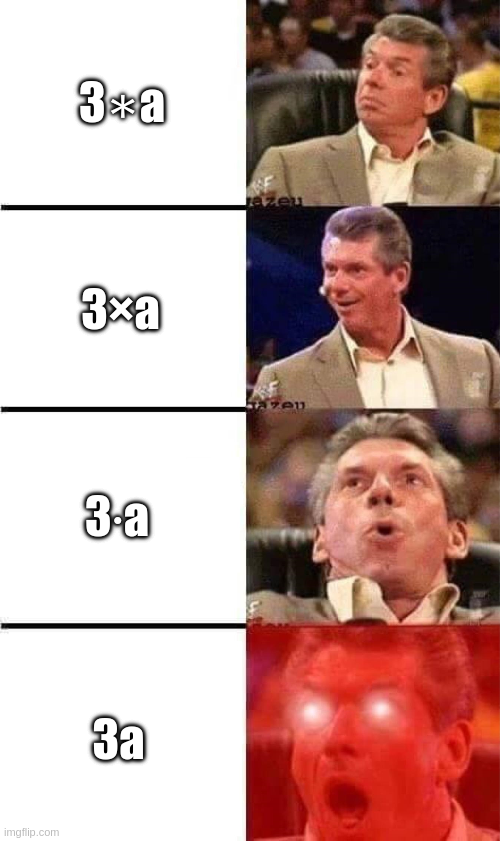
Because the things like 3a are only for variables, not numbers.