

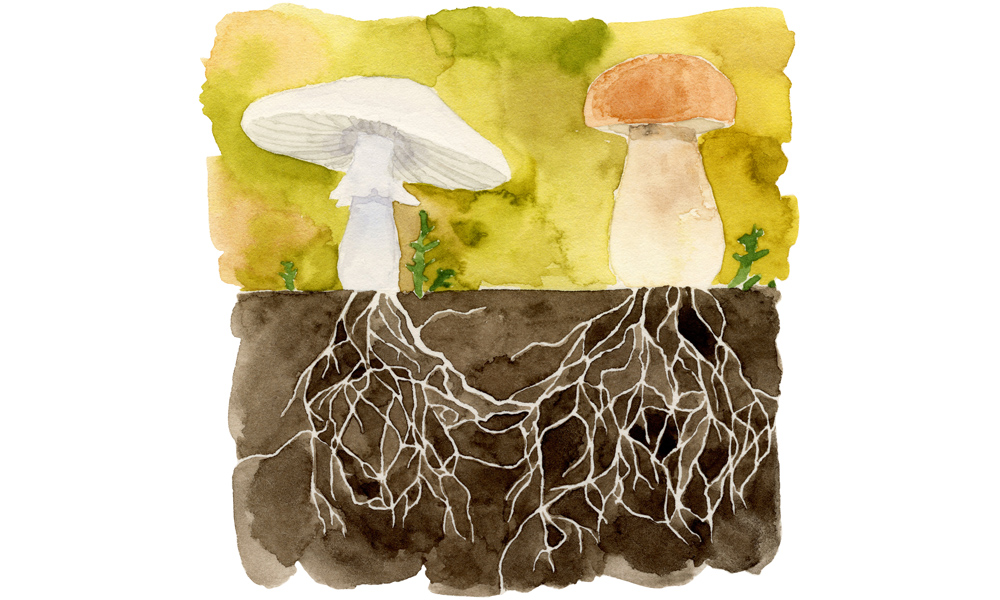
In recent decades, there has been an explosion of interest in these proliferating fungal networks, including mushrooms, which are the “fruit” of these organisms. Mycelia have been described as “the grand recyclers of our planet” because they disassemble larger molecules into simpler forms, creating ever-thickening layers of soil, unlocking nutrients, and sharing them in ways that can regenerate depleted environments. Some researchers believe that mycelium is a key to our evolutionary survival.
These densely interconnected networks have also evoked comparisons to the internet and have been nicknamed the “wood wide web.” In this analogy, mycelium functions akin to fiber optic cables by providing the infrastructure for a vast subterranean communication system. Apart from allowing plants and trees to share resources — sugar, nitrogen, and phosphorus — this network also allows them to communicate in the manner of a social network. While we have known for some time that trees “talk” to each other across significant distances using airborne hormones, we are just beginning to understand what occurs beneath our feet.
I prefer Suzanne Simard’s description of this network. Bypassing the technological metaphors, the forest scientist has shown how these fungal networks are patterned in ways that resemble the human brain (or perhaps more accurately, the human brain resembles these much more ancient networks). In the forest, trees actively perceive, communicate, and respond to one another by emitting chemical signals: “Chemicals identical to our own neurotransmitters. Signals created by ions cascading across fungal networks.”